
Draftt surfaces the financial cost of tech debt: extended support fees accumulating on every outdated component, orphaned resources burning budget with no business value, and untagged waste with no cost attribution. Quantify the cost of inaction and route accountability to the teams that can act.
Cloud providers charge escalating fees once technologies hit end of life. Most organisations are paying these fees today without realising it. Lambdas that have not been invoked in months, orphaned volumes, idle load balancers, and components deep in extended support are silently consuming budget.
annual extended support exposure reported by enterprise engineering leaders managing multiple outdated components across large estates.
of engineering capacity consumed by maintenance and firefighting: the largest hidden cost that never appears on a standard cost report.
cloud surface complexity expected by 2027, with no corresponding growth in headcount to goven and ensure cost optimization
Surface every source of financial risk
Draftt continuously scans your entire stack and surfaces four categories of FinOps debt: extended support fees already accruing on outdated components, unused resources consuming budget with no business value, untagged resources with no cost attribution, and AI model extended support fees that are an emerging line item most organisations are not yet tracking.


Quantify the cost of inaction
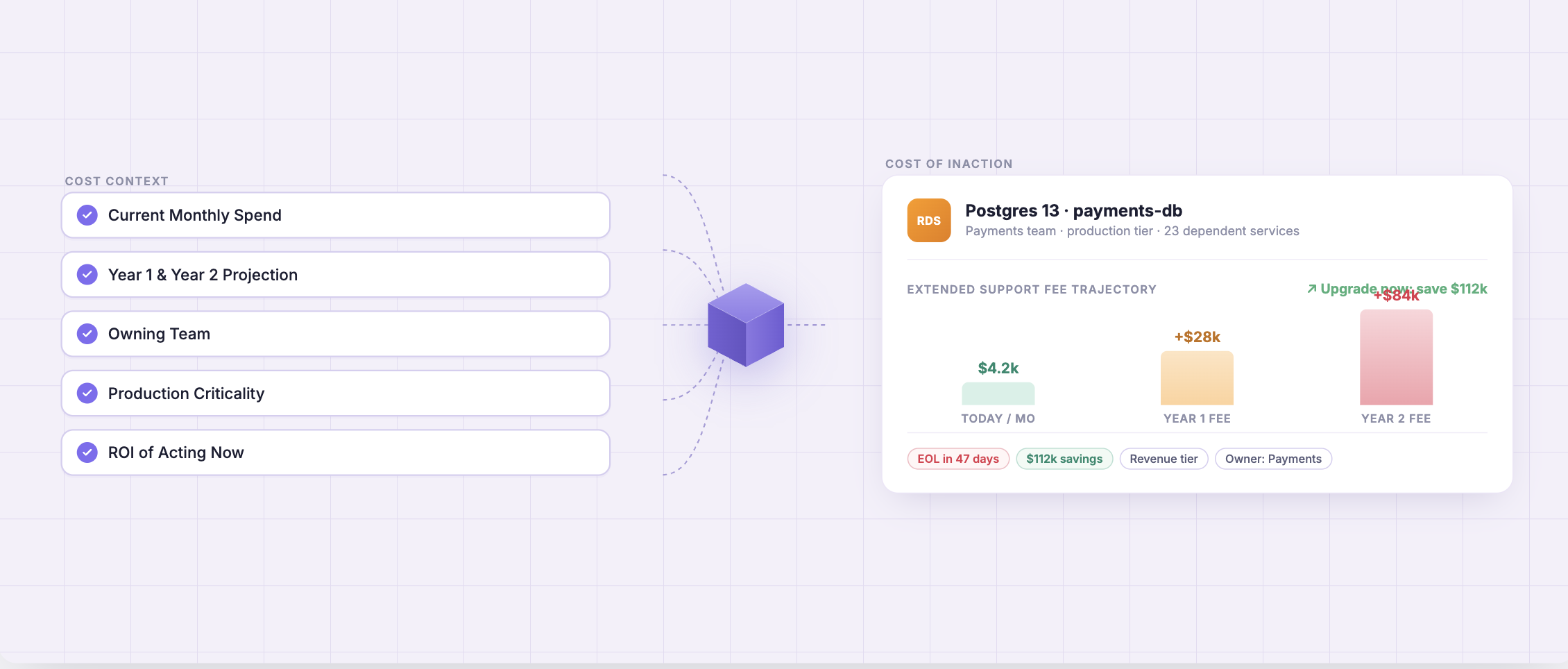
Draftt does not stop at showing what costs money today. It projects what inaction will cost over time: extended support fee trajectories, the financial impact of each deferred upgrade, and the business case for acting now versus deferring. Every finding is enriched with ownership context, production criticality, and a clear cost model that connects engineering decisions to finance conversations.
Agentic workflows to eliminate risks
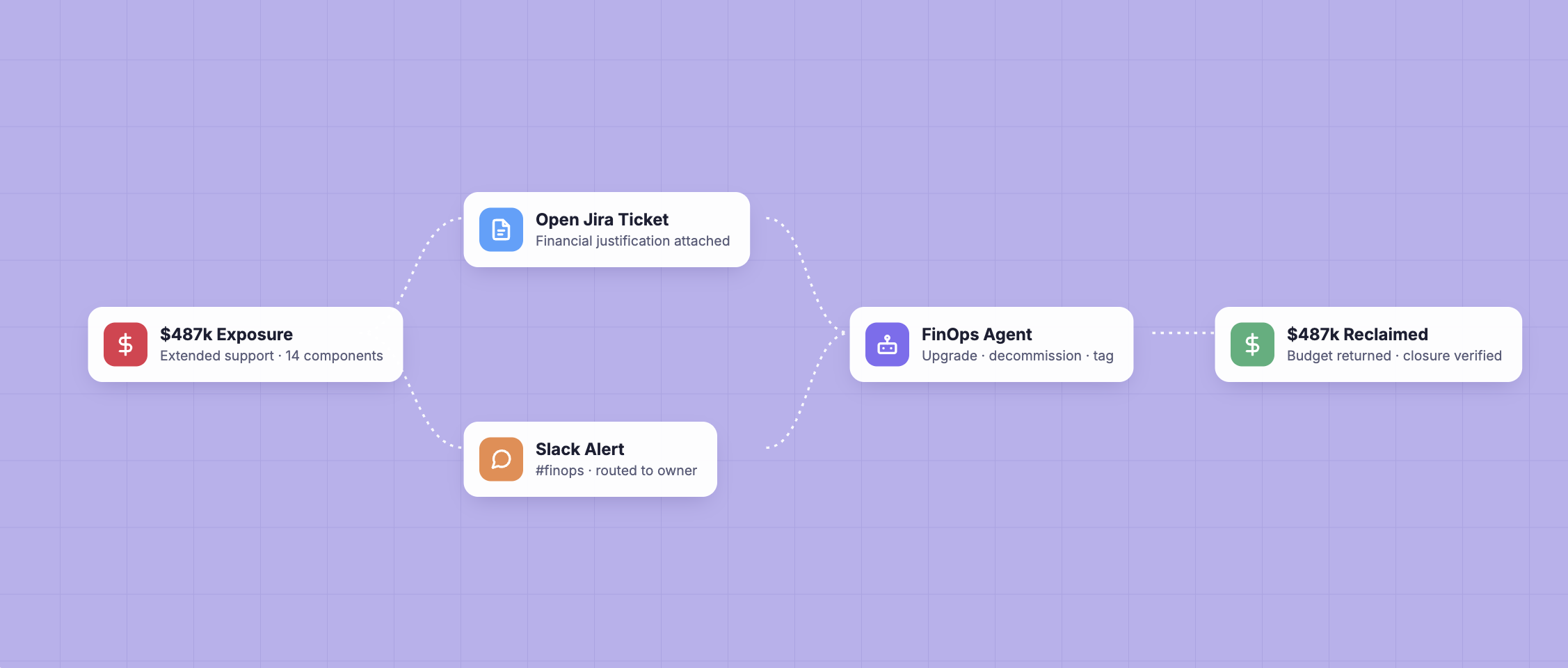
Draftt’s AI Agents Hub routes every FinOps debt finding to the right owner with full cost context, generates upgrade plans with financial justification attached, and tracks remediation to confirmed closure. For unused resources, findings include safe decommission guidance. For untagged resources, Draftt infers ownership and initiates the tagging workflow. Continuous debt elimination returns budget to the business rather than to extended support invoices.
Surface every source of financial risk
Draftt continuously scans your entire stack and surfaces four categories of FinOps debt: extended support fees already accruing on outdated components, unused resources consuming budget with no business value, untagged resources with no cost attribution, and AI model extended support fees that are an emerging line item most organisations are not yet tracking.
Quantify the cost of inaction
Draftt does not stop at showing what costs money today. It projects what inaction will cost over time: extended support fee trajectories, the financial impact of each deferred upgrade, and the business case for acting now versus deferring. Every finding is enriched with ownership context, production criticality, and a clear cost model that connects engineering decisions to finance conversations.
Agentic workflows to eliminate risks
Draftt’s AI Agents Hub routes every FinOps debt finding to the right owner with full cost context, generates upgrade plans with financial justification attached, and tracks remediation to confirmed closure. For unused resources, findings include safe decommission guidance. For untagged resources, Draftt infers ownership and initiates the tagging workflow. Continuous debt elimination returns budget to the business rather than to extended support invoices.
Surfaces current extended support fees accruing today, projected costs if no action is taken, and the financial trajectory by platform, technology, and team. For every deferred upgrade, Draftt calculates year one cost, year two escalation, and the ROI of acting now so engineering leaders can build business cases with real numbers.
Identifies storage resources using outdated or inefficient storage classes: AWS EBS GP2 volumes that should move to GP3, over-provisioned IOPS, and legacy storage classes no longer aligned with organisational standards. Draftt prioritises changes by both savings potential and risk, distinguishing safe high-confidence migrations from resources requiring performance review or production coordination.
Identifies resources that appear unused, abandoned, or no longer connected to an active service: unattached EBS volumes, idle databases, unused load balancers, stale snapshots, unused elastic IPs, and Kubernetes workloads with no recent activity. Each finding includes usage signals, cost footprint, dependency analysis, likely owner, and a recommended action with safe deletion confidence so teams can act without guesswork.
Enforces consistent tagging standards across all cloud resources for accurate cost allocation. Surfaces tag completeness across environments, identifies untagged or inconsistently tagged resources, and generates automated fixes for missing or incorrect tags. Draftt infers likely ownership from deployment context and initiates tagging workflows without manual effort.
Cloud providers are now applying extended support fees to AI model versions on Bedrock, Azure OpenAI, and other managed services. Draftt tracks model lifecycle status and surfaces the emerging cost exposure before it appears on the bill, an area most organisations are not yet monitoring.
Engineering and finance leaders can query the stack directly: which platforms are already in extended support, which components are bleeding budget, and what the financial exposure is by team or technology. Immediate answers without waiting for someone to pull a report.

Book a 30-minute walkthrough. We'll connect your cloud environment and show you what’s coming, what it'll cost to defer, and how to plan for it.